MX record lookup
Find out where a domain's email is delivered, which provider runs it, and whether its SPF and DMARC records protect it from spoofing.
Try: gmail.com · proton.me · github.com
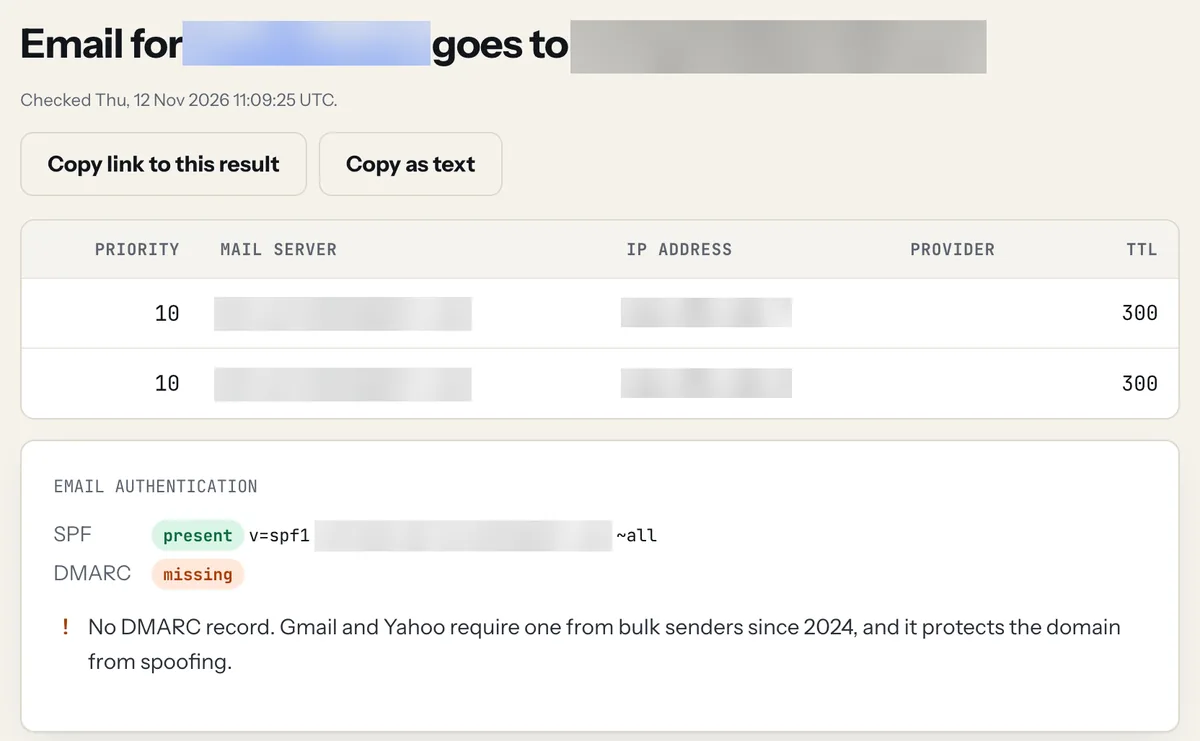
MX lookup: mail servers in priority order with their IPs, plus SPF and DMARC checks and what to fix.
What MX records do
MX (mail exchanger) records tell the world which servers accept email for a domain. Each has a priority number: senders try the lowest number first and fall back to the next if it doesn't answer. Two or more MX records with different priorities give you a backup.
The email problem most host moves cause
When you move a website, it's easy to change the name servers and forget that email records lived at the old host. MX, SPF and DKIM records must be copied to the new DNS provider before you switch, or email stops arriving. Run this check before and after any move, and compare.
SPF and DMARC in one line each
- SPF is a TXT record listing the servers allowed to send email as your domain.
- DMARC is a TXT record at
_dmarc.yourdomaintelling receivers what to do with mail that fails those checks, and where to send reports. Gmail and Yahoo have required it from bulk senders since 2024.
FAQ
How do I check the MX records of a domain?
Enter the domain above. You'll see every MX record with its priority, the mail server's IP address, the email provider we recognise, and the SPF and DMARC status.
Why am I not receiving email after changing hosts?
Usually the MX records weren't recreated at the new DNS provider, or they still point at the old host's mail server. Compare the MX results here with what your email provider says they should be.
What does MX priority mean?
Lower numbers are tried first. If records have the same priority, senders spread mail between them.
Can a domain have no MX records?
Yes. It then can't receive email. Some senders fall back to the domain's A record, but you shouldn't rely on that.
CHANGING HOSTS?
DNS is where most migrations go wrong. Follow the hosting switch checklist, lower your TTL a day before, and use the propagation checker after the switch. Comparing new hosts? See real renewal prices.